He spent 2 years on an app nobody used. A few emails with a stranger later, he makes $50K a month.
Florian never filmed a single video himself. He handed the whole thing to a Colombian creator he'd never met — paying with revenue share instead of a flat fee.
Before we start
What's the hardest part of building a product?
Is it writing code all day while also filming your own videos, writing your own copy, and running your own marketing?
Florian is an iOS developer from Austria.
He worked a day job and built his own apps at night — for years, with nothing to show for it.
His first app took 2 years to polish. When it shipped, only a few friends reluctantly used it.
His second app struggled for a year to reach a few hundred dollars a month.
Then he did one thing, and within 2 months his revenue jumped from $300 to $12K a month.
A few months later, $50K.
He never filmed a video himself. He just exchanged a few emails with a Colombian he had never met.
Consistency really is key, though it's been said a million times. You can largely force your luck to happen.
1. He spent 2 years building an app nobody used
Florian's first product was CORDI, an event-planning app.
He spent 2 years polishing it.
Every feature had to be perfect. Every screen got redesigned again and again.
Two years later, it finally launched.
And almost nobody used it.
He literally had to push his own friends to try it.
It became the lesson he reflects on most:
I was a 'perfectionist' about it and didn't want to launch it until it was absolutely perfect.
CORDI was eventually abandoned.
Those 2 years taught him one thing: ship it to real users — strangers, not friends — first, then iterate.
If you wait until it feels "perfect," you're usually already too late.
2. The second app crawled to $300/month after a full year
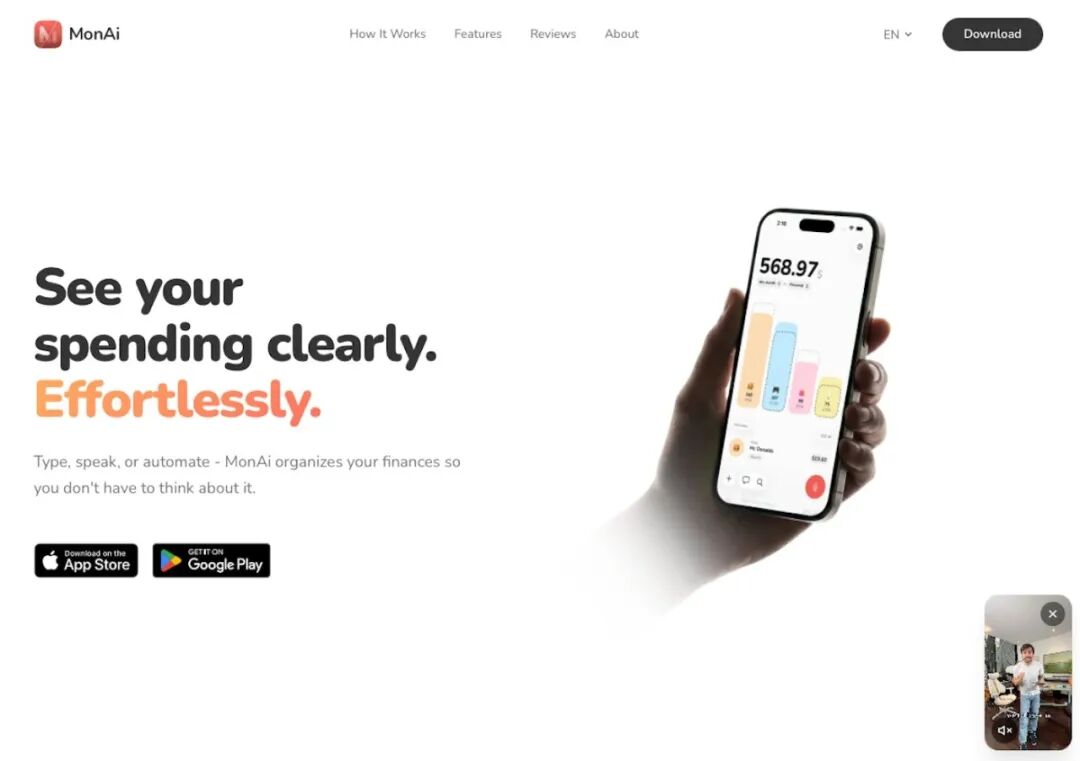
After CORDI failed, Florian started MonAi.
It's an expense-tracking app that uses AI to simplify input, built for people who find existing finance apps bloated.
This time he didn't spend 2 years.
He shipped fast.
But even after launch, MonAi's growth stayed slow.
After more than a year of grinding, it made a few hundred dollars a month.
He built the product. He did the marketing. He posted on every platform, wrote tweets, tried paid promotion.
Everything he could do, he did.
Growth just wouldn't come.
Then he did one small thing.
He put a Twitter link in MonAi's settings page.
The payoff wouldn't show up until a year later.
3. Then a Colombian found him on Twitter
Charlie Alvarez is a content creator from Colombia.
He makes Spanish-language videos for a mostly Latin American audience.
One day, Charlie used MonAi himself and liked it.
He opened the app's settings and saw Florian's Twitter link.
He sent Florian a DM.
They started talking.
Eventually, Charlie made an offer:
He would make videos for MonAi — no flat fee, just revenue share.
It was the first time anyone had ever approached Florian about a partnership.
He said yes.
4. Two months later: from $300 to $12K a month
So Charlie started filming.
Not the "you HAVE to see this app" viral-bait kind of short video.
He made story-driven videos: a real user scenario, a specific person logging an expense, explaining why they chose this app.
The videos were in Spanish, posted mainly to Instagram and TikTok, aimed at LATAM users.
The numbers moved fast.
Users coming from Instagram and TikTok activated the free trial at 14%.
Trial-to-paid conversion: 40–50%.
Only later did Florian understand why the combination worked so well.
The Spanish-language market has far less competition than the English one.
The same app, when he later tried expanding into the US market himself, didn't work.
But in LATAM, Charlie's story-driven videos produced absurd conversion rates.
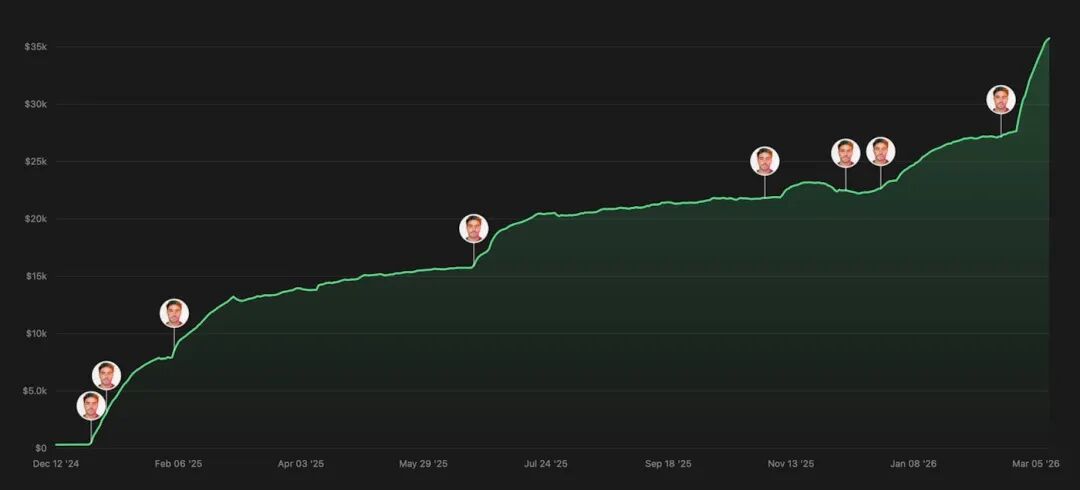
Two months later, MonAi's monthly revenue jumped from $300 to $12K.
5. A few months after that: $50K a month
Charlie's videos kept running.
Florian didn't sit still either — he shipped several new apps.
Mindr, a small tool for reminders that don't need exact times — things like "water the plants every so often," shown as a ring-style nudge.
Re-Frame, which turns an idle iPad into a digital photo frame for your iCloud albums.
Max, a task-prioritization app that helps indecisive people pick the next thing to do, with time estimates.
Today Florian's total monthly revenue floats between $40K and $60K — call it $50K.
MonAi alone contributes 90%.
In 2025 he went part-time at his job.
In January 2026, he formally quit his iOS developer position at the Austrian company.
He says if he could do it again, he'd look for a partner much earlier.
6. He doesn't want to go big. He wants to stay small.
Florian has no plans to turn MonAi into the next unicorn.
His reference point is DHH (the Basecamp founder): small, stable, built to last.
MonAi's pricing model has been adjusted along the way, too.
It started as freemium — free base version plus a paid premium tier — but App Store reviews kept complaining the free version was too limited.
So he switched to a hard paywall: free trial, then pay. Ratings and revenue both went up.
Lately he's also been testing paid ads.
But because the app's price point is low, paid acquisition still can't beat the ROI of Charlie's organic content.
I want to stay small; I'm not looking to scale an app into a unicorn.
What to steal from this
1. Not knowing how to make videos isn't your problem. Not finding someone who does — that's the problem.
The most common indie hacker bottleneck: "I can't do content."
But you don't have to do it yourself.
Florian never filmed a single video. He handed the entire job to a Colombian creator he'd never met.
Distribution is the heaviest part of making a product succeed — but it doesn't have to be you doing it.
If your product is visual and has a story to tell, find a mid-sized creator whose audience matches your target users, and offer revenue share instead of a flat fee.
What you can do right now: browse X, TikTok, Instagram, and YouTube. Find 3 mid-sized creators (10K–100K followers) whose audience matches yours. DM them and ask if they'd do a rev-share partnership. Send 3 — usually 1 will want to talk.
2. Bury a way to reach you inside your product.
Charlie only found MonAi's maker because Florian had put a Twitter link in the app's settings.
It looks like a tiny detail. Its payoff is the $50K/month Florian earns today.
No Twitter link in the app, no way for Charlie to reach him — and none of this story happens.
What you can do: check whether your product has an entry point that lets a real user reach you — you personally, not a support inbox, not a ticket system. An X link, a personal email, a Telegram handle... so the users who think "this is good, I want to talk to whoever made it" actually can.
3. Don't default to starting with the US market.
Florian also assumed the US was the biggest market.
But Charlie's Spanish-language videos converted far better in LATAM than Florian's own later attempts in the US.
It's a counterintuitive finding: users in emerging markets aren't necessarily less willing to pay — and there's far less competition.
The same app hit 14% trial activation and 40–50% trial-to-paid in LATAM, and couldn't get moving in the US.
Markets worth considering: Southeast Asia, Latin America, the Middle East. Purchasing power there is higher than most builders assume, and app competition density is 1–2 orders of magnitude lower than in the US and Europe.
Does this apply to you? If you build utility products — expense tracking, reminders, task management — with no strong cultural or regional binding, emerging markets are worth a test.
4. If a project isn't working after 2 years, the problem usually isn't the product.
Florian spent 2 years on CORDI. Not for lack of effort — for too much perfectionism. Two years later it launched to nobody.
With MonAi, growth was slow, but he shipped much faster — and that's how he was still standing when Charlie showed up.
Does this apply to you? If your product has been out for 6+ months with zero paying users who aren't your friends, the problem probably isn't insufficient polish. You've spent too long on the wrong product.
What you can do right now: list your product's actual users. If non-friend paying users < 10, stop adding features and go re-validate the need first.
Related
继续阅读
相关联的文章会根据标签和分类自动出现。现在文章还少,更多内容准备中。